How long do French and EU trademarks last?
A French trademark is valid for ten years from its filing date and is renewable every ten years, indefinitely. An EU trademark works the same way: ten years from the filing date, renewable in ten-year increments.
For a US-managed portfolio, the most important structural difference is what renewal does not require:
- No use declarations. There is no equivalent of the Section 8 or Section 71 declaration, no specimens of use, no declaration between the fifth and sixth year. Renewal before INPI and the EUIPO takes a request and a fee, nothing more.
- No incontestability filings. There is no Section 15 analogue. Instead, longevity produces its own advantages under French/EU law (see below).
Non-use still matters in Europe — but through a different door. A mark unused for five years becomes vulnerable to revocation for non-use if a third party attacks it, and its owner may be required to prove use when opposing. Non-use is a litigation risk, not a renewal formality. So a European renewal decision is a pure portfolio-management judgment: is this registration still worth its fee?
Why keep renewing? Priority in time is the currency of European trademark law. Only the holder of an earlier right can attack a mark, so the older your registration, the more of the register it outranks — and long-standing marks may also benefit from acquiescence (forclusion par tolérance), which bars an earlier owner who knowingly tolerated your registered mark for five years from attacking it.
Renewal windows and grace periods
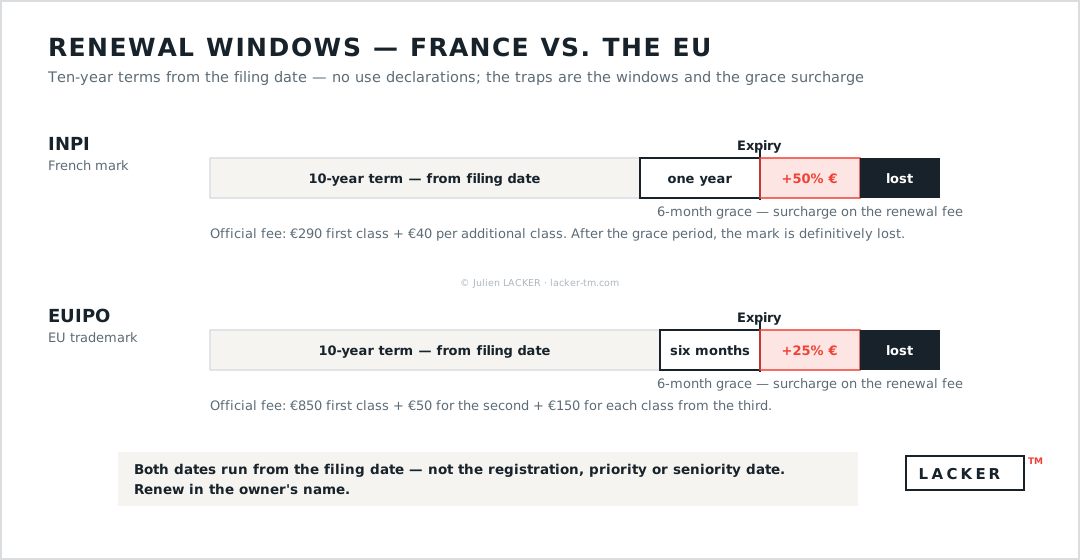
French marks (INPI)
- Earliest renewal: one year before the expiry date (i.e., from year 9).
- Normal deadline: the expiry date itself.
- Grace period: six months after expiry, with a 50% surcharge on the INPI fees.
- After the grace period: renewal is no longer possible and the mark is definitively lost.
EU trademarks (EUIPO)
- Earliest renewal: six months before the expiry date.
- Normal deadline: the expiry date.
- Grace period: six months after expiry, with a 25% surcharge on the EUIPO fees.
One recurring docketing error is worth flagging: the EUTM renewal date runs from the filing date — not the registration date, the priority date, or any seniority date. Portfolios migrated from US docketing systems keyed to registration dates should be audited for this. International registrations under the Madrid Protocol follow their own WIPO-centralized renewal cycle and are handled separately.
Renew in the name of the current owner — or the renewal is at risk
To be valid, a renewal must be made in the name of the current owner of the mark. If the registered owner has changed — assignment, merger, change of corporate name — the corresponding recordal must be entered on the register before renewal.
This is where US recordal habits create European problems. Chains of title left unrecorded for a decade have to be reconstructed at renewal time, sometimes involving entities that no longer exist — and a mark owned by a dissolved company can no longer be assigned at all. Treat every renewal as a scheduled chain-of-title audit. See assignment and recordals for how recordal works before INPI and the EUIPO.
Total or partial renewal
Renewal can be total (all classes of the original registration) or partial (some classes only). Partial renewal reduces the INPI fee, but it permanently narrows the scope of the mark — a real loss of rights, not just a cost saving. It is a reasonable choice where lines of business have genuinely been abandoned; it is a false economy where the goods might return or retain blocking value against competitors.
Official renewal fees at INPI and the EUIPO
Fees below are the official office fees; they come on top of attorney fees.
INPI (French marks)
€290 for one class + €40 per additional class. Examples: 1 class €290; 2 classes €330; 3 classes €370; 5 classes €450; 10 classes €650.
- French Polynesia extension: +€60 flat, regardless of the number of classes. (Protection of a French mark can be extended to French Polynesia at renewal; this may require prior validation for the past period.)
- Late renewal: 50% surcharge on the INPI fees during the six-month grace period.
EUIPO (EU trademarks)
€850 for the first class + €50 for the second + €150 for each class from the third. Examples: 1 class €850; 2 classes €900; 3 classes €1,050; 5 classes €1,350; 10 classes €2,100.
- Late renewal: 25% surcharge on the EUIPO fees during the six-month grace period.
For how these fit into overall portfolio budgeting, see trademark fees and costs.
Our fees
Our handling fee starts from €550 per renewal (French or EU mark), covering advice on the scope of the renewal, verification of the owner information on the register, filing the renewal request, payment of the official fee (rebilled at cost), monitoring through to confirmation, and delivery of the renewal certificate. Late renewals during the grace period start from €750 given the additional formalities. Regularizing an owner-change recordal, amending the specification, or a French Polynesia extension are quoted separately. Fees are billed in EUR or USD.
Portfolio management: how we run renewals for US clients
For US firms and in-house teams holding French and EU registrations, we operate as local renewal attorneys:
- Docketing and reminders keyed to filing-date-based deadlines, with the renewal window opening one year (FR) or six months (EU) before expiry.
- Pre-renewal audit of each record: current owner correctly registered, chain of title complete, address current — fixed via recordal before the renewal is filed.
- Scope review: a short recommendation on total vs. partial renewal per mark, informed by what you actually sell and by the blocking value of each class.
- Coordination with watching: a renewed mark is only as useful as your ability to enforce it, so renewal decisions pair naturally with a trademark watch and, where conflicts surface, opposition before INPI.
A note on lapsed marks: if a French mark passes the six-month grace period, it is gone — the only route back is a new application, with a new filing date at the back of the priority queue, and a fresh clearance search is prudent because the register will have moved on in the meantime.
Send us your list of French/EU registrations and expiry dates — contact us for a renewal quote and a chain-of-title check.
Written by Julien Lacker, attorney (avocat) admitted to the Paris Bar, certified specialist in intellectual property law and in information-technology law. Last reviewed: August 2026.