What an EU trademark covers: one filing, 27 countries
The EU trademark is a unitary right: a single registration that takes effect simultaneously and identically in every member state of the European Union. As of today that means 27 countries: Austria, Belgium, Bulgaria, Croatia, Cyprus, Czech Republic, Denmark, Estonia, Finland, France, Germany, Greece, Hungary, Ireland, Italy, Latvia, Lithuania, Luxembourg, Malta, the Netherlands, Poland, Portugal, Romania, Slovakia, Slovenia, Spain, and Sweden.
There is no EU equivalent of a state-by-state analysis: the EUTM cannot be limited to some member states. It is all 27 or nothing — a feature that cuts both ways, as explained below.
For a US in-house counsel, the closest mental model is a federal registration for a market of 27 “states” — except that, unlike a USPTO registration, the EUTM is granted without any proof of use: no specimens, no dates of first use, no statement of use, and no use-based maintenance filings during the life of the registration. Like French law, EU trademark law is first-to-file: rights are acquired by registration, not by use in commerce.
What is the EUIPO?
The EUIPO (European Union Intellectual Property Office) is the EU agency that administers EU trademarks and Community designs. Its former name was OHIM (Office for Harmonization in the Internal Market) — you will still see “Community trademark” (CTM) in older documents; it is simply the previous name of the EU trademark. The Office sits in Alicante, Spain, and every procedure can be conducted entirely online. It also cooperates with national offices such as France’s INPI and maintains extensive public databases and goods-and-services comparison tools.
One point of procedure matters immediately for US businesses: parties domiciled outside the European Economic Area must act through a qualified representative before the EUIPO for most proceedings (Article 120 EUTMR). As French avocats and EUIPO representatives, we act in that capacity for US companies and as foreign associates for US law firms.
Filing an EU trademark at the EUIPO: what to expect
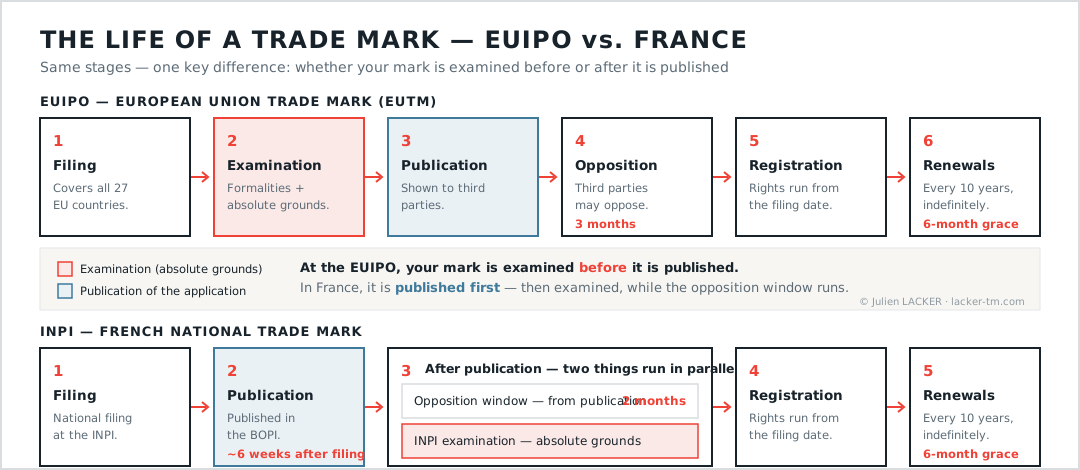
The application identifies the owner, the sign (word mark, logo, color, motion, 3D shape or sound mark), and the goods and services, classified under the same 45-class Nice Classification used by the USPTO. The strategic groundwork is identical to a French filing — choice of applicant entity, choice of sign, and a specification drafted for current use plus medium- and long-term expansion; see the discussion in French trademark registration, which applies here in full.
Key features of EUIPO prosecution:
- Official fees are €850 for the first class, €50 for the second, and €150 for each further class, a scale deliberately built to encourage focused one- or two-class filings.
- Examination covers absolute grounds (distinctiveness, descriptiveness, lawfulness). The EUIPO does not refuse applications on the basis of earlier rights; those are asserted by their owners through opposition. A sign must be distinctive across the whole EU: an objection valid in one language of the Union can block the entire application. US applicants with descriptive-leaning English-language marks should take that risk seriously.
- Opposition period: 3 months from publication of the application, longer than the 2-month French window. Even so, the overall EUIPO procedure typically runs faster than the French route to registration. If a conflict arises, see opposition proceedings before the EUIPO.
- Term: 10 years from the filing date, renewable indefinitely.
Before filing, a clearance search is even more valuable than for a national filing: because the EUTM is unitary, a prior right in any one of the 27 member states (including a purely national registration you would never encounter in US databases) can support an opposition against the whole application.
The all-or-nothing risk — and the conversion safety net
The unitary character of the EUTM is its strength and its weakness. An opposition based on a single national prior right — say, a Spanish registration — can defeat the EUTM application for the entire Union.
EU law softens this with conversion. If an EUTM application is rejected following an opposition based on a national mark, the applicant can convert the EU filing into national applications, keeping the original EU filing date. The EUIPO transmits the file to the national offices concerned. In the example above, an application defeated by a Spanish prior mark can be converted into a French application — and into national applications in every other member state except Spain. Conversion is a genuine rescue mechanism, but it multiplies national filings and fees; it is a fallback, not a plan.
The bridge works in the other direction too: a national registration (for example a French mark filed at INPI) can be the object of a seniority claim in a later EUTM, preserving the benefit of the earlier national date within the EU title.
EUTM or French national filing — or both?
There is no single right answer; this is a budget-and-risk allocation exercise. Our usual framework for US clients:
The EUTM is the natural choice when the business plan is genuinely European — distribution, e-commerce or licensing across several member states — and the clearance picture is reasonably clean. One filing, one renewal, 27 countries: at that scale the economics are hard to beat.
A French national filing deserves consideration when:
- France is the primary or first EU market, and €190 in official fees secures it without exposure to prior rights in 26 other countries;
- the clearance search reveals meaningful conflict risk elsewhere in the EU — a French mark cannot be dragged down by, say, a Bulgarian or Portuguese prior right;
- you want a solid, inexpensive basis or priority anchor for a broader program (Paris Convention priority within 6 months, later Madrid Protocol extensions, or a future seniority claim in an EUTM).
Both is often the mature answer for brands with a strong French center of gravity: the EUTM for breadth, the French registration as an independent national title that survives whatever happens to the EU right. The incremental cost is modest; the full comparison of official fees is on our fees page, where the two routes are set side by side.
For the full decision seen from the US side, including the Madrid route, see registering a trademark in France from the US.
Practical notes for US applicants
- Priority. A US application can serve as the basis for a Paris Convention priority claim in an EUTM filed within 6 months — align your US and EU filing calendars accordingly.
- No use declarations — but genuine use still matters. Nothing is filed at registration or renewal, but an EUTM unused in the Union can eventually be attacked for revocation for non-use. Registration strategy and use strategy must be designed together.
- Specifications translate poorly by copy-paste. US-style specifications drafted for USPTO practice (narrow, use-tested wording) are rarely optimal in the EU first-to-file context, where a specification should also cover planned expansion. We redraft rather than transplant.
- Fees can be billed in EUR or USD.
Planning an EU filing, or weighing EUTM against national routes? Contact us for a concrete recommendation on your facts.
Written by Julien Lacker, attorney (avocat) admitted to the Paris Bar, certified specialist in intellectual property law and in information-technology law. Last reviewed: August 2026.