What is an EUIPO opposition?
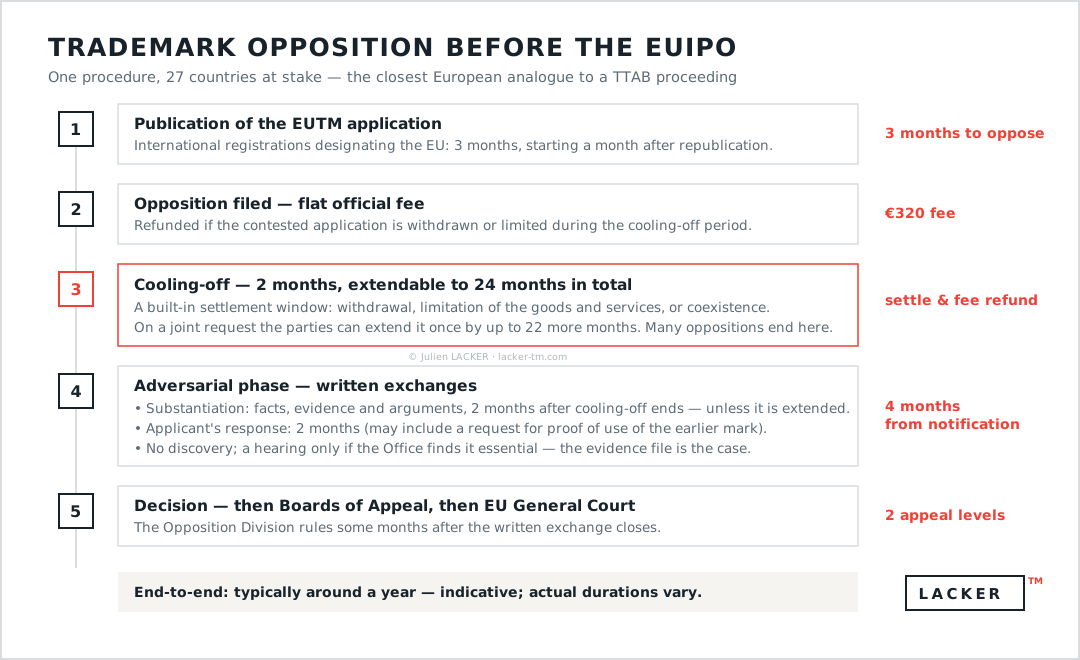
An EUIPO opposition is the administrative procedure for blocking an EU trademark (EUTM) application — or an international registration designating the European Union — before it registers. The EUIPO (European Union Intellectual Property Office, based in Alicante, Spain; formerly OHIM) administers EU trademarks and Community designs, and its Opposition Division decides these cases at first instance. The entire procedure runs online.
For a US practitioner, the mental model is a TTAB opposition with three structural differences:
- Everything is written. No discovery, no depositions, no testimony periods, no oral hearing in the ordinary course. Evidence goes in as documentary exhibits attached to written submissions.
- Deadlines are the procedure. Each phase is a fixed window; missing one generally forfeits the corresponding right, and there is no US-style stipulated-extension culture outside the specific mechanisms described below.
- The stakes are 27 countries at once. A successful opposition defeats the application for the entire EU — which is also why the conversion mechanism (below) matters to the applicant.
Like the INPI, the EUIPO cannot award damages or enjoin use; it decides registration only. Compare the French national procedure at trademark opposition before the INPI.
What is the EUIPO opposition deadline?
The opposition must be filed within three months of publication of the EUTM application in the EU trademarks bulletin. For international registrations designating the EU, the same three months run from one month after republication, with the opposition filed at the EUIPO.
Three months sounds comfortable next to the two-month French window, but the practical advice is the same: by the time a conflicting application surfaces through informal channels, much of the window is often gone. A structured trademark watch against EUTM publications is the standard risk-management tool for brands with European exposure.
What earlier rights can support an EUIPO opposition?
An EUIPO opposition may be based on:
- an earlier EU trademark (formerly “Community trademark”);
- an earlier national trademark of any EU member state — a single French, German or Benelux registration can block an EU-wide application;
- other rights beyond trademarks, such as a company name — provided the right is of more than merely local significance.
A distinctive feature compared to the INPI: you can invoke multiple earlier rights without any increase in the official fee. The opposition fee is flat regardless of the number of grounds and the number of marks relied on.
The substantive analysis is the EU likelihood-of-confusion framework — comparison of the signs and comparison of the goods and services — familiar in structure to anyone who briefs Section 2(d) cases, applied under the case law of the EUIPO and the EU courts.
How much is the EUIPO opposition fee?
The EUIPO opposition fee is €320, whatever the number of grounds or earlier marks invoked. Attorney fees come on top and depend on the complexity of the comparison work; we bill in EUR or USD. For overall budget framing across filing and contentious work, see trademark fees and costs.
Unlike the INPI fee — which is never refunded, even on settlement — the EUIPO opposition fee is refunded when the contested application is withdrawn or limited during the cooling-off period. That refund rule is a genuine negotiation lever: it lets an opponent offer the applicant an exit at no fee cost to either side if the dispute resolves early.
What is the EUIPO cooling-off period?
Once the opposition is filed and admissible, the procedure opens with a two-month “cooling-off” period during which nothing happens procedurally — by design. The purpose is to give the parties room to settle: withdrawal, limitation of the goods and services, or a coexistence agreement. The cooling-off period can be extended by agreement of the parties, up to a total of 24 months.
This is where a large share of EUIPO oppositions actually end. A well-drafted limitation of the applicant’s specification frequently gives the opponent everything it needs — and triggers the fee refund if it happens within cooling-off.
What happens in the adversarial phase of an EUIPO opposition?
If no settlement is reached, the adversarial phase runs on fixed clocks:
- Opponent’s substantiation — the opponent has two months from the end of the cooling-off period to complete the opposition: full argumentation, evidence of the earlier rights, comparison of signs and of goods and services.
- Applicant’s response — the applicant then has two months to respond.
- Decision — once the adversarial exchange closes, the Opposition Division typically takes three to four months to issue its decision.
End to end, an EUIPO opposition runs around twelve months on average, absent an extension of cooling-off or a suspension of the procedure.
What is a proof of use request?
Where the opponent’s earlier mark has been registered long enough to be subject to the use requirement, the applicant can require the opponent to prove genuine use of that mark for the goods and services relied on; earlier rights for which use is not proven drop out of the comparison. This is a standard defensive move in EUIPO practice and a key filter on older portfolios. The use requirement bites when the earlier mark had been registered for more than five years at the filing date (or priority date) of the contested application; the applicant must make the request with its first response, and the opponent is then given two months from the Office’s invitation, extendable on request, to file its proof. The strategic takeaway for US counsel is straightforward: before opposing on a mark more than five years old, audit your use evidence the way you would before a TTAB nonuse counterclaim — except that here there is no discovery, so the evidence file you assemble is the case.
What language is used in EUIPO opposition proceedings?
EUIPO proceedings are conducted in one of the office’s procedural languages, and English is available in practice for opposition work — a material convenience for US parties, who can read every submission in the case without a translation layer. Our firm handles EUIPO procedures in English or French, and represents clients before the Opposition Division, the Cancellation Division and the Boards of Appeal, as well as before the General Court of the European Union. Technically, the language of the opposition is drawn from the two languages the applicant designated for the contested EU trademark — its first language (any official EU language) and its second language, which must be one of the EUIPO’s five working languages: English, French, German, Italian or Spanish. That second-language rule is what puts English on the table so often.
Can an EUIPO opposition decision be appealed? (Boards of Appeal and conversion)
Opposition Division decisions are appealable to the EUIPO Boards of Appeal, the office’s integrated appellate body — an affordable and efficient appeal route compared to court litigation. Board decisions can in turn be challenged before the General Court of the EU.
For the applicant who loses an opposition based on a national mark, EU law provides a safety net worth knowing: conversion. The defeated EUTM application can be converted into national applications keeping the original filing date — in every member state except those where the conflicting earlier right operates. Example from practice: an application defeated on the basis of a Spanish mark can be converted into a French application, and into national applications in each EU country other than Spain. This shapes settlement dynamics: even a winning opponent has not necessarily cleared the applicant out of every European market.
Where does the EUIPO opposition fit in a US brand’s strategy?
For a US brand owner, the EUIPO opposition is the cost-effective chokepoint: one flat-fee procedure, in English, that resolves the conflict for the whole EU before registration — instead of country-by-country enforcement after it. Upstream, a proper clearance search before EU trademark registration identifies who might oppose you; downstream, if your client’s application is the one opposed, the response options and deadlines are covered at responding to a trademark opposition.
Considering an opposition or just served with one? Contact us — we can assess the file and the deadlines within days, in English.