What is an INPI opposition, and how does it compare to a TTAB opposition?
An opposition before the INPI (Institut National de la Propriété Industrielle, the French PTO) is the administrative procedure for blocking the registration of a French trademark application — or of an international registration designating France — on the basis of earlier rights. Functionally, it is the French counterpart of an opposition before the TTAB: an inter partes proceeding decided by the office, not a court, and entirely separate from infringement litigation before the judicial courts.
The differences matter more than the resemblance, and they are the ones that catch US practitioners off guard:
- The deadlines are short and strictly enforced. The opposition window is two months from publication — not the three months (extendable) you know from USPTO practice. There is no French equivalent of a routine extension request.
- The procedure is entirely written. There is no discovery, no depositions, no testimony periods, no trial. Either party may ask to be heard by an INPI panel, but the decision rests on the written file. The case is won or lost on the notice of opposition, the written arguments and the documentary exhibits.
- The INPI decides registration only. Like the TTAB, the office cannot award damages or issue injunctions against use of the sign. Those remedies belong to infringement proceedings before the courts.
The opposition procedure is optional: an earlier rights holder who misses the window is not without remedies, but will have to pursue the later mark through a cancellation action or litigation instead. Systematic trademark watching is what makes the two-month window usable in practice.
What is the deadline to file an INPI opposition?
A French application is published by the INPI in the Bulletin Officiel de la Propriété Industrielle (BOPI) roughly six weeks after filing. Publication starts the two-month opposition period open to third parties.
Two practical consequences for US counsel:
- If a French application conflicts with your client’s rights, the clock is already running by the time most clients notice the filing. A watch service that flags publications immediately is the only reliable trigger.
- If no opposition is filed within two months, the INPI proceeds to registration (provided the mark is distinctive and lawful, and the goods and services are sufficiently precise).
For international registrations designating France, the opposition is filed before the INPI as well — the national office handles oppositions against the French extension.
What grounds can support an INPI opposition?
An INPI opposition may rely on one or several grounds (“fondements”), each ground being an earlier right invoked against the application:
- An earlier trademark, whether registered or still pending. If the earlier mark has been applied for but not yet registered, the opposition is suspended until it registers.
- A company name (dénomination sociale).
- Under certain conditions, a trade name, a shop sign or a domain name.
One notable exclusion: copyright cannot serve as a ground for an INPI opposition. A copyright claim against a trademark has to be raised in court, not in opposition. This is a real difference from what a US practitioner might expect from a broad “prior rights” clause. In practice, the number of grounds rarely exceeds three or four.
On the substantive side, the analysis is the familiar likelihood-of-confusion framework: comparison of the signs (visual, phonetic, conceptual) and comparison of the goods and services — the same building blocks you would brief in a TTAB opposition, applied under EU-harmonized French case law. For background on how earlier rights constrain what can be registered, see trademark validity and third-party rights.
What are the INPI opposition fees?
The INPI opposition fee is €400 for a single ground, plus €150 for each additional ground:
| Grounds invoked | INPI fee |
|---|---|
| 1 | €400 |
| 2 | €550 |
| 3 | €700 |
| 4 | €850 |
| 5 | €1,000 |
The formula continues at €150 per additional ground (ten grounds would cost €1,750, although that is rarely sensible).
One point worth flagging to clients up front: the INPI opposition fee is never refunded, even where the parties settle amicably. This differs from the EUIPO, where the fee can be recovered if the contested application is withdrawn during the cooling-off period — see trademark opposition before the EUIPO.
How much are attorney fees for an INPI opposition?
Our fees for an INPI opposition start from €600 (excluding VAT; INPI official fees are additional). Fees can be billed in EUR or USD. A straightforward opposition — one trademark ground, highly similar or identical signs, short and closely matching lists of goods and services — sits at the bottom of that range; a well-prepared INPI opposition typically represents three to eight hours of attorney work.
The main cost drivers:
- number and type of grounds invoked (earlier marks or other rights);
- length of the lists of goods and services to compare;
- degree of similarity between the signs;
- overall complexity of the file.
The engagement covers the detailed analysis of the signs, an exhaustive comparison of the goods and services, research of relevant case law, drafting of the opposition form and full structured argumentation, payment of the INPI fee (recharged at cost) and correspondence through confirmation of filing. Subsequent phases — negotiating a coexistence agreement, replying to the applicant’s arguments, appeal — are quoted separately. A broader view of French and EU filing and enforcement budgets is at trademark fees and costs.
How does an INPI opposition procedure work, and how long does it take?
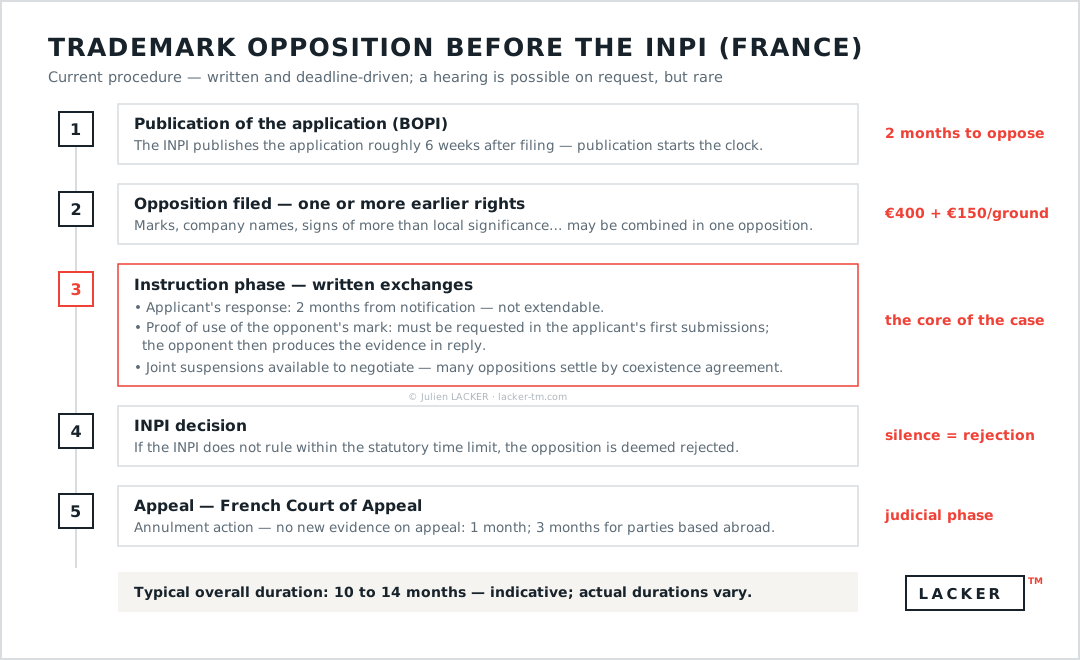
After filing, the opposition enters an instruction phase managed by the INPI, built around exchanges of written submissions between the parties: the opposition with its argumentation (comparison of the signs, comparison of the goods and services, supporting case law), the applicant’s response, and further exchanges as the case requires. The applicant’s response deadline is two months from notification and is not extendable.
Depending on how the procedure develops, a typical INPI opposition runs ten to fourteen months overall. The parties may jointly request suspensions of the procedure to negotiate — a mechanism the INPI provides precisely to encourage amicable settlement, often through a coexistence agreement defining how the two signs will operate side by side.
What are the possible outcomes of an INPI opposition?
The INPI’s decision can uphold the opposition in whole or in part (refusing the contested application entirely, or only for the conflicting goods and services) or reject it. Because the INPI acts as an administrative authority, the decision affects registration only: no damages, no injunction, no attorney-fee shifting comparable to litigation. If use of the sign in the marketplace is the real problem, opposition is one tool among several, alongside a cease-and-desist letter or infringement proceedings before the courts.
Can an INPI opposition decision be appealed?
INPI opposition decisions can be challenged before the competent French Court of Appeal — most often the Paris Court of Appeal, although venue can vary under the applicable allocation rules. Technically the challenge takes the form of an annulment or reformation action against the INPI’s decision. This is a genuinely judicial phase, with its own procedural rules and deadlines, and should be budgeted separately from the opposition itself.
Where this fits in a filing strategy
For US brand owners, the INPI opposition is both a sword and a risk to plan around. Before filing in France, a clearance search identifies the earlier rights most likely to oppose — and French filing strategy should factor the two-month exposure window into launch timing. If your client is on the receiving end, see responding to a trademark opposition.
Facing a deadline or a conflicting French filing? Contact us — we handle INPI oppositions daily, in English.
Written by Julien Lacker, attorney (avocat) admitted to the Paris Bar, certified specialist in intellectual property law and in information-technology law. Last reviewed: August 2026.