What counts as trademark infringement in France
French law — the term is contrefaçon de marque — covers two distinct situations, and it is worth keeping them apart when you brief a client.
The first is the one everyone pictures: goods or services sold under a mark without the owner’s authorization. Typically, these are fake products — copies of the originals that do not come from the trademark owner.
The second is broader and is where most contested cases live: using a name or sign that is identical or similar to an earlier mark, for identical or similar goods or services. There is no need for a counterfeit package or a fake product. Selling genuine, non-copied products under a sign that imitates someone else’s registered mark is infringement all the same.
One point that regularly surprises US clients: in civil infringement matters, good faith is irrelevant. The defendant’s intent, knowledge, or innocent adoption of the sign does not defeat a civil infringement claim in France.
Identity, imitation, and the likelihood of confusion
Where the signs and the goods are identical, the analysis is short. The harder, and more common, question is imitation: the use of a sign that is similar, but not identical, to the registered mark.
French decision-makers assess similarity from three angles: visual, phonetic, and conceptual (what French practice calls “intellectual” similarity). Imitation is established when the signs are similar and create a likelihood of confusion.
Two real decisions illustrate how far this reaches:
- Conceptual similarity across languages. The Paris Court of Appeal held that the mark “PETIT DEJEUNER DE LA PEAU” infringed the earlier mark “SKIN BREAKFAST” (Paris Court of Appeal, December 17, 2003). The French sign is, in substance, a translation of the earlier English-language mark — and that conceptual overlap was enough.
- Visual and phonetic similarity. The French PTO (INPI) found EBITDA similar to the earlier word mark EBTILDA (INPI, April 9, 2024, OP 23-3902). The decision reasoned (free translation) that the signs share six letters, near-identical beginnings and endings (EB- / -DA), the same three-beat rhythm, and that the differing middle sequence “is not such as to dispel the strong overall resemblance.”
The practical lesson for US counsel: do not assume a French or EU court will see the differences your client sees. Sequences of letters, sound patterns, and meaning — including meaning across languages — all count.
Which French courts hear trademark cases?
Trademark disputes in France belong exclusively to the judicial courts (tribunaux judiciaires), and representation by a French attorney (avocat) is mandatory there — only an avocat can validly represent a trademark owner before the Judicial Court. For EU trademark infringement claims, the Paris Judicial Court has exclusive jurisdiction as France’s EU trademark court, which is one reason a significant share of European enforcement work runs through Paris attorneys.
There is no US-style discovery in France. You cannot count on document requests and depositions to build your case after filing. Evidence is assembled before and outside the courtroom — which is why the French system gives rights holders dedicated tools, including the saisie-contrefaçon, an evidence-seizure procedure with no direct US equivalent, covered in the evidence section below.
What remedies are available for trademark infringement?
A successful infringement action before the French courts can deliver:
- An injunction prohibiting continuation of the infringing acts, typically backed by an astreinte — a court-ordered penalty per day or per violation, which gives the injunction real teeth.
- Damages. French law compensates the harm the trademark owner actually suffered and managed to prove. There are no punitive damages on the US model, and no jury: the award is what the evidence supports, before a professional judge.
- Online measures. Courts can order technical intermediaries to transfer or cancel a domain name, or to take down all or part of a website. Short of court action, it is possible in some cases to ask the host to suspend hosting and deactivate a site or specific pages.
- Cost recovery. France applies a loser-pays principle: under article 700 of the Code of Civil Procedure, the court orders the losing party to contribute to the winner’s attorney fees. Recovery is at the court’s discretion and rarely covers everything, but it changes the settlement calculus on both sides.
Enforcement strategy differs depending on whether the infringement is online or involves physical distribution of products — the takedown levers, the evidence, and the defendants you can reach are not the same.
Strategic options when your client’s mark is infringed
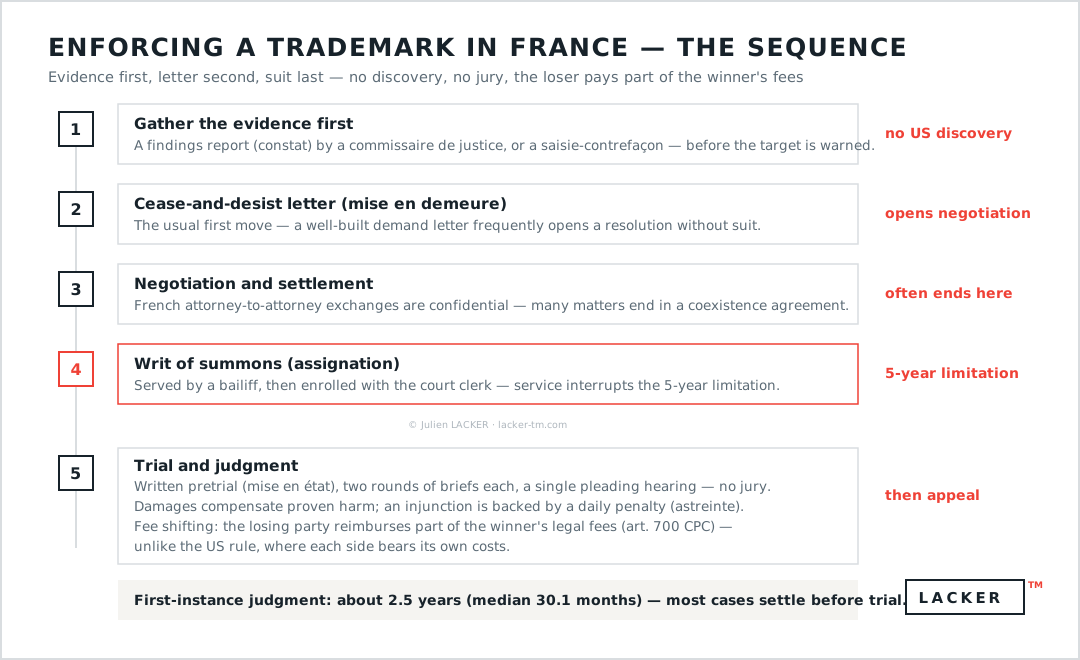
Litigation is rarely the first move. A French infringement suit is a heavy procedure: it takes time and investment — attorney fees, bailiff costs, expert costs, procedural charges — to prove infringement, and roughly two and a half years to obtain a first-instance judgment (median observed: 30.1 months across 518 judgments of the Paris court in our database), sometimes longer. It is best treated as one option among several:
- Cease-and-desist first, where the situation lends itself to it. A well-built demand letter (mise en demeure) from a French attorney frequently opens a resolution without suit. See cease-and-desist letters in France.
- Evidence before speed. Stopping the infringement fast can be critical, but it is often necessary to secure court-grade evidence first — evidence you can still use if the matter goes to trial. See evidence of infringement in France.
- Settlement and coexistence. Litigation is not always the fastest or cheapest way to resolve a trademark conflict; a negotiated outcome often is. See amicable settlement of trademark disputes.
- Opposition, if the infringer filed a trademark application. You can oppose within two months of publication for a French application and three months for an EU trademark application. See opposition before the INPI and opposition before the EUIPO. If the window has closed, an invalidity action remains possible.
- Full litigation. Suing — serving a writ of summons (assignation) — is the radical option, often best kept as one of the last resorts, though sometimes it is the only serious one. See trademark litigation in France.
Statute of limitations: the five-year deadline
The limitation period for trademark infringement in France is five years. Article L716-4-2 of the French Intellectual Property Code provides (free translation): “The infringement action is time-barred five years from the day the right holder knew or should have known the last fact enabling him to exercise it.” Infringement is generally treated as a continuing wrong (renewed each day it goes on), but damages for older acts can slip away, and delay weakens both leverage and remedies. If a US client has known about a French infringement for years, that history needs to be on the table at the first call.
How we work with US counsel
Our role is typically to act as French litigation and enforcement attorneys alongside US in-house teams or outside counsel: assessing the strength of the French or EU rights, securing evidence, sending or answering demand letters, and litigating before the French courts, including the Paris Judicial Court in EU trademark cases. Julien Lacker has litigated trademark cases in France for more than twenty years, including ten years within a US law firm — which helps when translating French procedure into terms a US legal department can act on.
Facing an infringement issue in France or the EU? Contact us to discuss the fastest sensible route to stopping it.
Written by Julien Lacker, attorney (avocat) admitted to the Paris Bar, certified specialist in intellectual property law and in information-technology law. Last reviewed: August 2026.