Why clear a mark in France and the EU at all
Under French law, a mark must satisfy absolute requirements — distinctiveness, lawfulness, no deceptive character — but it must also not infringe third-party rights. Neither INPI (the French office) nor the EUIPO examines relative grounds ex officio: your application can sail through examination and still be opposed, invalidated, or become the basis of an infringement claim the day you start using it.
That is the point of a clearance search (in French practice, a recherche d’antériorité): to determine whether a sign is available — meaning it can be registered and used without exposing you to opposition, cancellation or infringement liability and damages — before you commit filing fees, packaging, and a launch budget to it.
For US counsel, the key structural point is this: your US full search covers USPTO records, state registrations and US common-law use. It tells you nothing about the French register, the EU trademark register, or international registrations designating France or the EU. Availability is assessed territory by territory, and the analysis is run under European standards.
What prior rights can block a mark in France
The grounds on which a mark can be refused or annulled in France are broader than many US practitioners expect. The main category is earlier trademarks:
- Earlier registered marks — identical or similar signs covering identical or similar goods or services, where there is a likelihood of confusion. This is the French/EU counterpart of a Section 2(d) analysis, but decided under CJEU-derived criteria (visual, phonetic and conceptual comparison, global assessment).
- Earlier marks with a reputation — where the earlier mark has a reputation, it is protected even against use on dissimilar goods and services, without any likelihood-of-confusion requirement.
Beyond trademarks, French law recognizes a non-exhaustive list of other prior rights, including:
- company names (dénominations sociales);
- trade names, shop signs and domain names, where there is a likelihood of confusion in the public’s mind;
- registered geographical indications;
- copyright;
- protected French or Community designs;
- personality rights — family names, pseudonyms, a person’s image;
- the rights of French local authorities in their name, image or reputation.
No search can cover all of these. There is no copyright register, so earlier copyrights cannot be searched at all. In practice, searches focus on registered trademarks and company names, and we recommend also checking earlier domain names used in a related field of activity. French company names can be searched through the Trade and Companies Register (RCS).
Identical search vs. similarity search
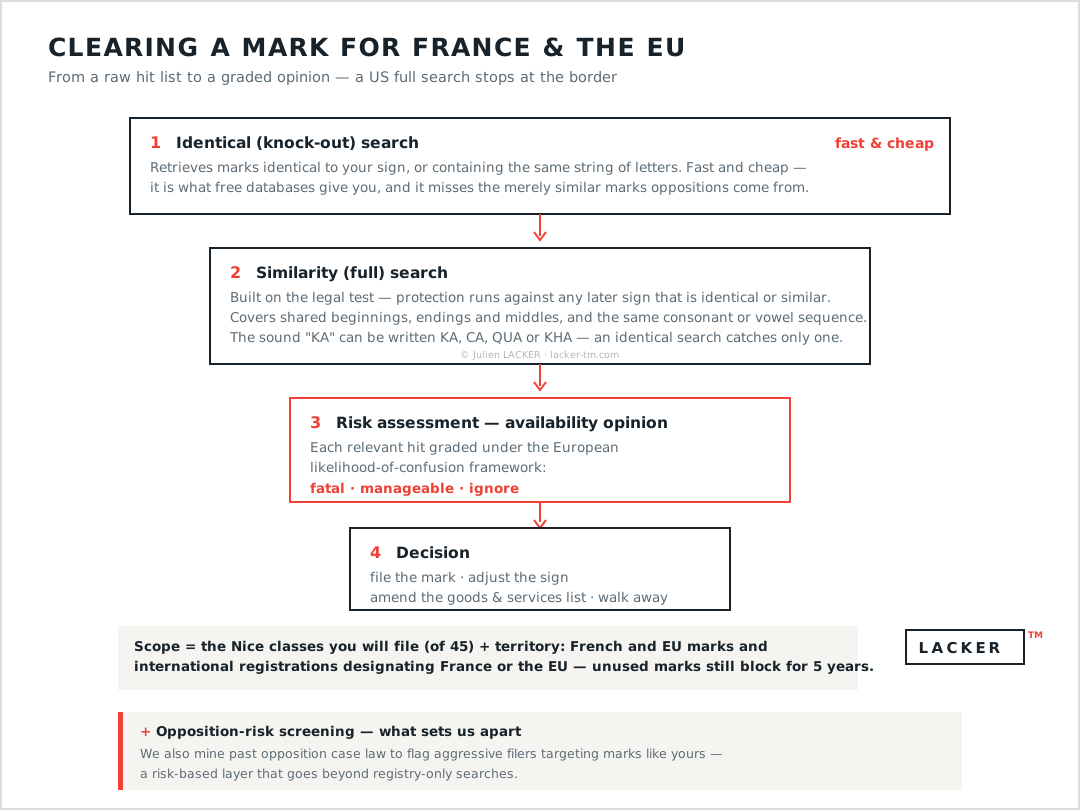
There are two levels of search, and the difference matters when you decide how much risk assessment to buy.
The identical (knock-out) search
An identical search retrieves marks that are identical to your sign or contain the same string of letters. It is fast and cheap, and it is what free online databases give you. It will not surface marks that are merely similar rather than identical — which is precisely where most European oppositions come from.
The similarity (full) search
A similarity search (recherche de similarité) is built around the legal test: a registered mark is protected against any later sign that is identical or similar, with similarity assessed visually, phonetically and conceptually. The search engines therefore generate candidate lists covering:
- marks sharing the same beginning, ending or middle;
- the same sequence of consonants, or the same sequence of vowels;
- the same letters in a different order;
- phonetically identical or similar marks.
The phonetic layer is where identical searches fail most visibly. To take the French example used on our source pages: the sound “KA” can be written KA, CA, QUA or KHA. An identical string search catches one spelling; a similarity search catches all four.
Scoping by class and territory
Two parameters drive the scope (and cost) of any search:
- Classes. There are 45 Nice classes. The search is limited to the classes that are identical or similar to the goods and services you intend to file for — so you need a working specification before the search, not after. See our note on French filing practice.
- Territory. For a French filing, the search must cover French marks, EU trademarks, and international registrations designating France or the EU. For an EU trademark, a single earlier national right in any one of the 27 Member States can support an opposition — which is why EU clearance is inherently more demanding, and why Madrid Protocol designations should be cleared per territory.
From search report to risk assessment
A raw hit list is not an opinion. The lawyer’s work is applying the European likelihood-of-confusion framework to each relevant hit: how close are the signs visually, phonetically, conceptually; how close are the goods and services; how distinctive is the earlier mark; who is the relevant public. The output you should expect is a graded risk assessment — which hits are fatal, which are manageable (coexistence, limitation of the specification, a different territory strategy), and which can be ignored.
The depth of that assessment scales with what you ask for. A more complete search and analysis costs more because it takes more attorney time; the trade-off is between a knock-out check before brainstorming shortlists and a full opinion before a launch you cannot easily reverse. A mark that clears search is also worth protecting going forward: clearance tells you the register today, a watch service tells you who files next to you tomorrow, and if a conflicting application does appear, the opposition route before INPI is the cost-effective response.
Practical points for US filers
- Do the search before filing, not after. In France and the EU there is no use requirement to file, so the register is crowded with marks you will never see in the marketplace. Marketplace-based clearance instincts from US practice systematically under-detect European risk.
- Unused earlier marks are still a threat — for five years. An earlier registration can block you even if it has never been used; only after five years does it become vulnerable to a non-use defense or cancellation.
- Clearance and filing strategy interact. Search results often drive the choice between a national French filing, an EUTM, or a Madrid designation — and sometimes the addition of a distinctive logo to strengthen a weak word mark.
Fees
Search fees depend on the number of classes, the territories covered, and the depth of analysis (knock-out vs. full similarity search with a written opinion). A full similarity search with a written availability opinion starts from €1,405 for one class, fees and disbursements included. That price covers the French register, the EU trademark register and international registrations designating France or the EU, and it applies to word marks: searches on logos and other figurative signs are quoted separately. Fees are billed in EUR or USD.
Official register access itself involves no office fee; see trademark fees and costs for the filing fees that typically follow a clean search.
How we work
GOMIS & LACKER runs French, EU and international clearance from Paris: identical and full similarity searches across FR/EUTM/international registers and French company names, followed by a written availability opinion with concrete recommendations — file, modify, or walk away. We regularly act as European clearance attorneys for US firms and in-house teams ahead of EU launches.
Ready to clear a mark for France or the EU? Contact us for a scoped quote within one business day.
Written by Julien Lacker, attorney (avocat) admitted to the Paris Bar, certified specialist in intellectual property law and in information-technology law. Last reviewed: August 2026.