What is an international trademark under the Madrid system?
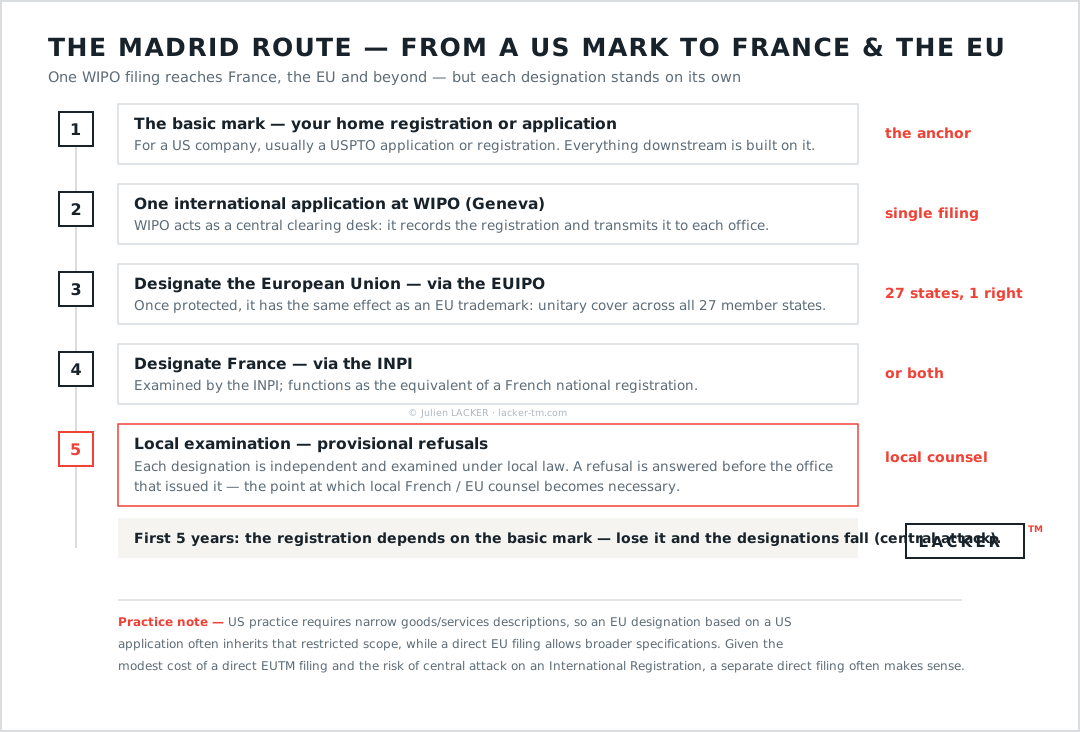
An international trademark is a registration filed with the World Intellectual Property Organization (WIPO) in Geneva, designating several countries in a single application. WIPO acts as a central clearing desk: it receives the application, records the international registration, and transmits the request to the trademark office of each designated jurisdiction.
The name misleads. There is no worldwide trademark right. Each designation is examined under the national (or regional) law of the designated office and, once accepted, functions as the equivalent of a national registration there. Each designation is independent of the others: a refusal in one country has no effect on the rest.
US practitioners know this system through TEAS and the USPTO’s role as office of origin under the Madrid Protocol; what follows is the view from the receiving side — France and the EU — where we act for US applicants and their counsel.
The basic mark and the five-year dependency period
An international registration must be built on a prior basic mark — an existing application or registration in the holder’s home system. For a US company that will usually be a USPTO application or registration; the basic mark can equally be a French mark or an EU trademark, or a national mark of another country, which is precisely why the choice deserves thought (see below).
For its first five years, the international registration is dependent on that basic mark. If the basic mark is cancelled, refused or restricted during those five years, the international registration falls with it, to the same extent. Attacking the basic mark during this window in order to bring down the entire international structure is known as the central attack, a standard aggressive move that any opponent’s counsel will evaluate.
This is a serious, structural consideration for US-based filings: a US basic registration remains exposed to non-use cancellation and other challenges under US law, and any such loss within the dependency period propagates worldwide. (After a central attack, the holder can convert the affected designations into direct national or regional applications — a mechanism called transformation — provided it files within three months of the cancellation, keeping the international registration’s original date.)
Designating the European Union, France — or both
From a Madrid filing, a US holder can reach Europe two ways:
- Designate the European Union. The designation is processed by the EUIPO and, once protected, has the same effect as an EU trademark: unitary protection across all 27 member states. It also inherits the EUTM’s structural trait: a successful opposition based on a single national prior right defeats the designation for the whole Union.
- Designate France. The designation is examined by INPI and functions as the equivalent of a French national registration. It carries the same strategic advantages we emphasize for direct French filings: independence from prior rights in the other 26 member states, and coverage of what is often the key enforcement market.
The two are not mutually exclusive, and the reasoning developed for direct filings (EUTM breadth versus French resilience) applies unchanged when routing through Madrid.
Remember also the calendar: a first filing — for example a US application, or a French application used as the anchor of a European program — opens a 6-month priority window under the Paris Convention within which subsequent filings, including Madrid designations, can claim its date.
Weighing Madrid against a direct French or EU filing? See registering a trademark in France from the US.
Provisional refusals in France and the EU: how to respond
WIPO does not examine substance. Each designated office applies its own law and may issue a refusal against the designation — in Madrid terminology, a provisional refusal — exactly as it would object to a locally filed application. For France and the EU that means, in particular, objections on absolute grounds (distinctiveness, descriptiveness) and oppositions by owners of earlier rights (see responding to a trademark opposition).
Practical realities for a US holder:
- The refusal must be answered before the office that issued it, under that office’s own procedure and in its language, within a deadline the office fixes itself (typically a matter of months, and in some cases extendable).
- Local representation becomes necessary at this point. Before the EUIPO, parties domiciled outside the European Economic Area must in any event act through a qualified representative for most proceedings (Article 120 EUTMR). Before INPI, foreign holders responding to a refusal or opposition will likewise act through French attorneys: French law requires holders with neither a domicile nor a place of business in the EU/EEA to appoint a qualified representative for proceedings before the office. This is the typical configuration in which US law firms instruct us as their French/EU foreign associate.
- Because refusal practice differs office by office, a specification cleared by the USPTO can still draw objections in Europe. Descriptiveness is assessed against all EU languages, and classification practice differs; anticipating this at the Madrid filing stage is cheaper than litigating it designation by designation. A pre-filing clearance search covering France and the EU is the standard precaution.
What are the advantages of the Madrid system?
The system’s genuine strength is administrative. The international registration is renewed in a single operation at WIPO, rather than through separate renewals in every national office, a material saving for a portfolio spread over many countries. Subsequent designations can extend the same registration to new countries as the business grows, and recordals are centralized as well.
The trade-offs, summarized:
| Madrid designation | Direct national/EU filing | |
|---|---|---|
| Filing | One application at WIPO | One per office |
| Renewal | One renewal at WIPO | One per office |
| Dependency | Tied to the basic mark for 5 years (central attack) | None |
| Examination | Local law applies in full, via provisional refusals | Local law applies in full, directly |
How much does a Madrid Protocol filing cost?
Madrid fees are paid in Swiss francs, so the EUR/USD equivalent fluctuates with exchange rates. The amount depends on several variables: whether the mark is in black-and-white or in color (a factor that, among the systems discussed on this site, matters only for international marks), the number of classes, the office of origin of the basic mark, and the number and identity of the designated countries. The interplay is complex enough that WIPO publishes an official fee calculator on its site, which we use when preparing estimates; for direct INPI and EUIPO filings, see our consolidated fees and costs page. Our firm’s fees for Madrid strategy and for handling French/EU designations and refusals are quoted case by case and billed in EUR or USD.
Strategy before mechanics
The recurring mistake we see is treating Madrid as a checkout flow. The consequential decisions come earlier: which mark and which specification to use as the basic mark (knowing everything downstream depends on it for five years), whether to designate the EU, France, or both, how to sequence filings within the priority window, and how to budget for the provisional refusals that a multi-country program statistically will produce. That is trademark strategy, not form-filling, and it is where local European counsel earn their keep.
Extending a US brand to France or the EU through Madrid? Contact us to review your designations before you file.
Written by Julien Lacker, attorney (avocat) admitted to the Paris Bar, certified specialist in intellectual property law and in information-technology law. Last reviewed: August 2026.