What happens when your trademark application is opposed?
In France, the INPI publishes a trademark application in the Bulletin Officiel de la Propriété Industrielle (BOPI) roughly six weeks after filing. Publication opens a two-month window for third parties to oppose. If no opposition arrives (and the INPI raises no irregularity), the office registers the mark, provided it is distinctive and lawful and the goods and services are sufficiently precise. Before the EUIPO, the window is three months from publication.
When an opposition does arrive, US counsel should recalibrate away from TTAB reflexes on one point above all: timing. Before the INPI, the deadline to respond is two months from notification of the opposition — and it is not extendable. There is no consent motion, no stipulation, no suspension of proceedings available for the response itself. Whatever analysis, evidence gathering and client alignment needs to happen must happen inside that window, which is why the file should reach a specialist attorney as early as possible, not in week seven.
Before the EUIPO, the rhythm differs: the procedure opens with a two-month cooling-off period designed for settlement, after which the opponent has two months to complete its argumentation and the applicant then has two months to respond. The structure gives an opposed EUTM applicant more runway — but the deadlines, once running, are just as fixed. Details of the opponent’s side of both procedures: INPI opposition and EUIPO opposition.
The procedure on both tracks is entirely written — no discovery, no depositions, no hearing. Your response brief and its exhibits are the whole defense.
What happens if you don’t respond to a trademark opposition?
It can be tempting, especially for a secondary mark or an early-stage product, to let the opposition run unanswered. That is usually an error, for reasons that go beyond the immediate application:
- A reasoned response can save the application. Developing the pertinent arguments — on the comparison of the signs, the comparison of goods and services, the weakness of the opponent’s mark — regularly results in registration despite the challenge, in whole or for the goods and services that matter.
- Defaulting creates a precedent against you. An unanswered opposition typically produces a decision refusing the application on the opponent’s version of the facts. That decision limits the future use of the name — both through the refusal itself and through the reasoning of the INPI’s decision, which the opponent will cite in every subsequent skirmish.
- The strategic picture is broader than one filing. The right answer is sometimes to fight, sometimes to negotiate, sometimes to refile differently. The specialist attorney’s first task is exactly that assessment: realistic chances of success and the strategic options they open. Our track record in these procedures is summarized at results.
Every response is built on the specific facts of the case, after review of all useful elements — there is no template defense worth filing.
What are your options when your trademark is opposed?
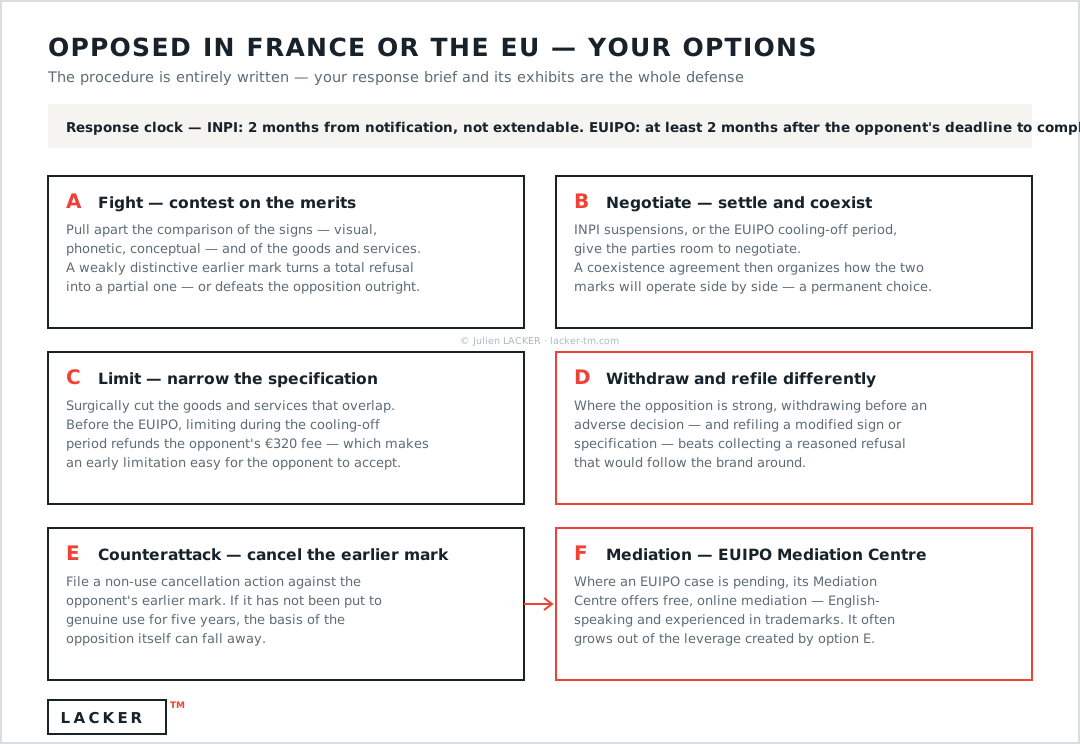
Fight: contest the opposition on the merits
The core of a contested response is the same analytical work as the opposition itself, run in reverse: pulling apart the comparison of the signs (visual, phonetic, conceptual), the comparison of the goods and services, and the scope actually protected by the opponent’s earlier right. Where the earlier mark is weakly distinctive, or the overlap in goods and services is partial, a full response often converts a total refusal into a partial one — or a rejection of the opposition outright.
Negotiate: settlement and coexistence agreements
Both offices are built to accommodate settlement. Before the INPI, the parties can jointly obtain suspensions of the procedure precisely to negotiate; before the EUIPO, the cooling-off period exists for that purpose and can be extended. The classic instrument is the coexistence agreement: a contract organizing how the two marks will operate side by side — commitments on the form of the signs, on the goods and services each party will cover, sometimes with a geographic dimension. Done properly, it removes the legal uncertainty and the cost of opposition or litigation; it can take the form of a signed agreement or even an exchange of sufficiently precise letters. It is not suited to every situation — a coexistence agreement is a permanent constraint on the brand, and should be priced as one.
Limit: narrowing the specification
Often the cheapest exit is surgical: limiting the application’s list of goods and services to remove the overlap that motivated the opposition. Before the EUIPO there is a financial incentive to do it early — if the contested application is withdrawn or limited during the cooling-off period, the opponent’s €320 official fee is refunded, which makes an early limitation easy for the opponent to accept. Drafting the limitation is precision work: cut too little and the opposition proceeds; cut too much and the registration no longer covers the business. How specifications are built in the first place is covered at choosing a trademark.
Fold strategically: withdraw and refile differently
Where the opposition is strong, withdrawing before an adverse decision — and refiling a modified sign or specification, in France or via EU trademark registration — can be better than collecting a reasoned refusal that will follow the brand around. This is a judgment call that depends on the opponent’s rights, the client’s timeline and the markets at stake.
How do you respond to an INPI irregularity notification?
Not every threat to a French application comes from a third party. The INPI itself examines applications and issues irregularity notifications, and their number has been rising steadily as the office tightens its scrutiny, notably on distinctiveness. A notification may target:
- the sign itself — lack of distinctive character, deceptiveness, or conflict with public policy;
- the goods and services — terms that are too vague, or items filed in the wrong class.
Responding is squarely in the applicant’s interest: without a response, the INPI simply decides — accepting or refusing all or part of the mark on the file as it stands. A response gives the examiner every useful element to assess whether the mark is distinctive and whether the goods and services are sufficiently precise.
Three hard rules frame the exercise:
- The sign cannot be amended after filing. If the mark is refused for lack of distinctiveness, the only path is a new filing built around a distinctive element. Anticipation (vetting the sign before filing) is the real protection here; see choosing a trademark.
- Misclassified goods trigger a fee. Where a product sits in the wrong class, the INPI requires its transfer to the correct class and payment of the corresponding fee, €40 per additional class. Unpaid, the office refuses the mark in whole or in part. Fees, where they arise in our engagements, can be billed in EUR or USD.
- The filing fee is never refunded. A refused application is sunk cost, which is the economic argument for professional drafting of the specification at the filing stage — most irregularity notifications are avoidable.
What to send your French counsel on day one
When an opposition or an irregularity notification lands, the response clock is already running. The useful package: the notification itself with its date, the application as filed, everything known about the opponent and its earlier rights, evidence of the client’s use and plans for the mark, and any prior correspondence with the opponent. From there, the assessment — fight, negotiate, limit, or refile — can usually be delivered within days, well inside the two-month window.
Opposed in France or before the EUIPO, or facing an INPI notification? Contact us with the notification date — the deadline analysis comes first.
Written by Julien Lacker, attorney (avocat) admitted to the Paris Bar, certified specialist in intellectual property law and in information-technology law. Last reviewed: August 2026.